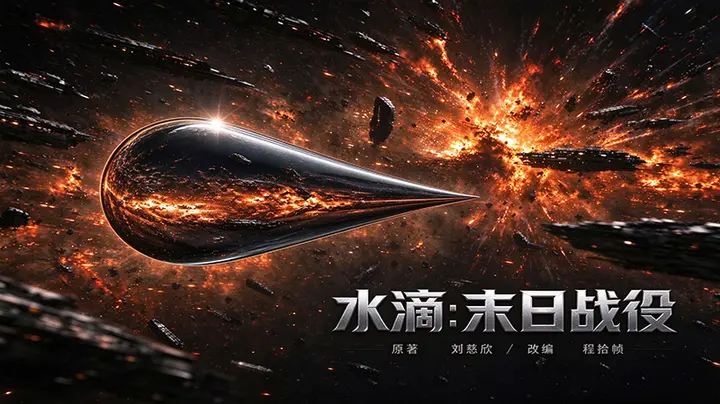
Droplet: Doomsday Battle
Video samples
Image gallery
10 images. Switch to view the full visuals.
Work description
I. Project Highlights
High-density storyboard narrative capability. The Droplet: Doomsday Battle completes a full four-act narrative arc in 1 minute 45 seconds—from collective human revelry to scientific warning, then to instant destruction, and finally to silent judgment. The rhythm of all 32 shots is timed precisely to the second.
AIGC execution of complex cinematic language. For example, the Hitchcock zoom (dolly zoom) is used at the emotional peak when Ding Yi sees the truth, using background collapse to externalize the dual psychology of cognitive isolation and falling into an abyss. Another example is the non-human FPV perspective, using a hexagonal geometric lock-on frame, barrel distortion, edge chromatic aberration, and a one-frame sharp-angle turn to visually encode an other-than-human perspective beyond human perception.
Physically self-consistent sci-fi worldbuilding. Fully sealed full-face helmets, internal holographic warning projections, visor fogging, and saliva droplets—emotional externalization is achieved under fully sealed conditions, with no logical loopholes.
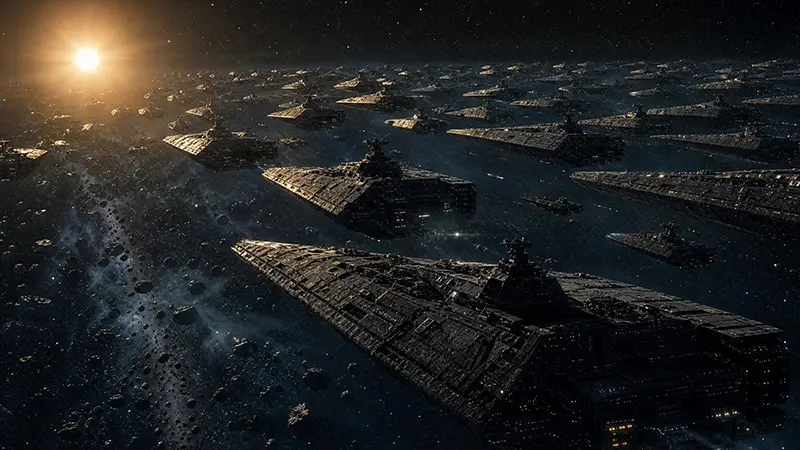
Mirror aesthetics and material expression. The droplet’s nearly perfect reflective mirror surface, the volumetric flames of warship explosions, and the layered material rendering of metal wreckage—complex reflections and volumetric depth are hard thresholds for AIGC, and also areas we repeatedly refine.
II. Production Workflow
Starting from a literary IP or original screenplay, first create the story outline and emotional curve design.
Break it down into a complete storyboard script, specifying shot size, camera movement, composition, sound effects, and duration for every shot.
Lock keyframe concept art and visual anchors to maintain character and scene consistency across shots.
Perform shot-by-shot prompt engineering and identity consistency verification.
Generate final frames and conduct quality review.
Connect to downstream video generation tools to complete editing and compositing.
III. Tech Stack
The storyboard scripting stage mainly uses Claude and GPT series large models for literary breakdown, shot language design, and prompt engineering.
Concept art and keyframes use Seedream 4.5 and 5.0 models for scene generation, character design, and material expression.
Identity consistency is achieved through reference-image anchoring plus image_edit, ensuring as much as possible that characters and props do not drift across shots.
Video generation uses Seedance 2.0 and 2.5 models to achieve shot dynamization and camera movement effects.
Post-production compositing uses DaVinci Resolve and Topaz for color grading, upscaling, and detail restoration.
IV. Applicable Industries
Film and animation industry, suitable for concept design, storyboard previsualization, iconic scene redrawing, and short film production.
Gaming industry, suitable for CG promotional trailers, worldbuilding concept art, character and vehicle design, and cutscenes.
Literature and IP operations, suitable for novel visualization, dynamic manga of iconic scenes, and IP derivative short videos.
Technology and branding, suitable for futuristic product concept videos, launch event visuals, and sci-fi-style advertising.
V. Delivery Formats
Deliverables include storyboard scripts in Markdown or Excel format, with shot-by-shot parameter tables ready for execution.
Keyframe concept art and final shot-by-shot frames are in high-resolution PNG or JPG format, named by storyboard number.
Final videos are output in MP4 format, with optional subtitles.
Prompt engineering documentation is in JSON or Markdown format, with the complete prompt and parameters for each image documented.
Reusable asset packs organize character anchors, scene templates, and style presets by category.
VI. Reusable Capabilities
After one collaboration, your project’s visual style—including color palette, materials, and typography—will be saved as presets.
Reference image assets for core characters and props are retained long-term and can be directly reused in new projects without regeneration.
Shot templates for similar genres can be applied directly, shortening timelines.
The complete prompt and parameters for each image are recorded, making fine-tuning or regeneration extremely low-cost.
Comments
Author information
Related works
Light recommendations with similar tags or style.